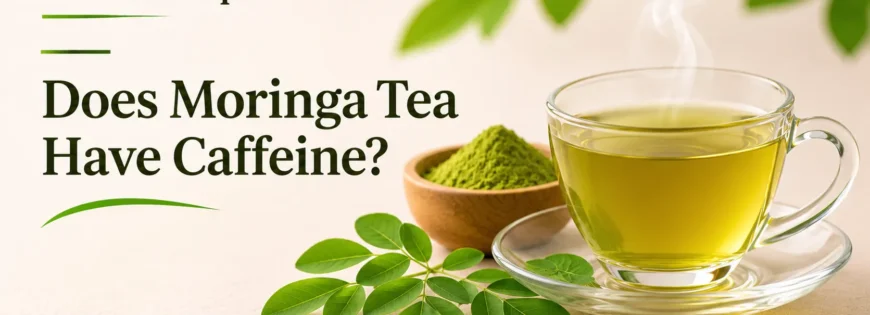
Does Moringa Tea Have Caffeine?
Does moringa tea have caffeine? Pure tea made only from moringa leaves is naturally caffeine-free. Unlike black tea and green tea, moringa leaf tea does not come from the caffeine-containing tea plant, Camellia sinensis.
The important word is pure. A blend sold as moringa tea may also contain green tea, black tea, yerba mate or another caffeine-containing ingredient. If you are avoiding caffeine, check the complete ingredient list rather than relying on the product name.
Does Moringa Tea Have Caffeine Naturally?
Moringa leaves do not naturally contain caffeine. When dried moringa leaves are steeped on their own in hot water, the resulting drink is a naturally caffeine-free herbal infusion. This makes a pure moringa leaf infusion different from drinks brewed with leaves of the tea plant.
Moringa is commonly made from the leaves of Moringa oleifera, a tree whose leaves are used in foods and drinks in many parts of the world, including Pakistan. The dried leaves produce an earthy, green and slightly vegetal drink. Depending on the leaves and brewing time, some cups may also taste mildly bitter.
Although people often call it “moringa tea,” a drink made solely from moringa leaves is technically an herbal infusion or tisane. In everyday conversation, “tea” can refer to both true tea and herbal drinks. On a product label, however, that distinction matters when you are checking for caffeine.
Moringa caffeine content in blends
A packet labelled “moringa tea” is not necessarily made from moringa alone. Some blends combine moringa leaves with green tea or black tea for a different flavour, and those tea leaves naturally contribute caffeine. Ingredients such as yerba mate and guarana are also sources of caffeine.
If the label says only “moringa leaf,” without other ingredients, the leaves themselves are not a natural source of caffeine. If it lists several ingredients, check each one before assuming the drink is caffeine-free. When the ingredient list is unclear, contact the seller or manufacturer for clarification.
Moringa Tea vs Other Teas: Where Does Caffeine Come From?
Caffeine occurs naturally in the leaves of Camellia sinensis, the plant used to make black, green, white and oolong tea. These teas differ in processing and flavour, but all normally contain caffeine. The amount in a cup varies with the tea, serving size and brewing method.
Herbal drinks are made from other plants or plant parts, such as leaves, flowers, roots and spices. Many single-ingredient herbal infusions contain no naturally occurring caffeine, but “herbal” is not a guarantee: a blend can contain both herbs and caffeinated ingredients. The table below compares common drink choices.
| Drink | Typical ingredients | Caffeine consideration |
|---|---|---|
| Pure moringa leaf tea | Moringa leaves | Naturally caffeine-free |
| Moringa and green tea blend | Moringa leaves and green tea | Contains caffeine from green tea |
| Green tea | Camellia sinensis leaves | Naturally contains caffeine |
| Black tea or plain chai | Camellia sinensis leaves, sometimes with milk | Naturally contains caffeine |
| Pure hibiscus infusion | Hibiscus calyces | Naturally caffeine-free |
| Pure chamomile infusion | Chamomile flowers | Naturally caffeine-free |
A longer steep or a larger serving of black or green tea can affect how much caffeine ends up in the cup. By contrast, steeping pure moringa leaves for longer does not create caffeine. It can, however, make the flavour stronger and more bitter.
This distinction can be useful for tea drinkers in Pakistan who enjoy regular chai or green tea but want a different option later in the day. For a closer comparison of ingredients and flavour, read about moringa tea vs green tea. The choice is not simply between “tea” and “herbal tea”; it depends on what is actually in the cup.
How to Choose Caffeine-Free Moringa Tea
The simplest choice is a product that clearly lists moringa leaf as its only ingredient. Loose leaves, tea bags and powdered leaves may all be made from moringa, but their labels should identify what is inside. Packaging that describes a drink as “natural” or “herbal” does not, by itself, confirm that every ingredient is caffeine-free.
Look for a clearly named plant part and a complete ingredient list. A food or beverage label should also provide practical details such as the supplier, storage instructions and a best-before date. If you are particularly sensitive to caffeine or must avoid it for medical reasons, ask the manufacturer about possible cross-contact during processing as well as the ingredients.
When comparing products, use this checklist:
- Ingredient list: Look for moringa leaf on its own if you want a single-ingredient infusion.
- Added tea leaves: Green, black, white and oolong tea contribute caffeine.
- Other caffeine sources: Yerba mate and guarana are ingredients to check for in blends.
- Plant part: Choose a product intended for consumption and labelled as moringa leaf rather than an unidentified plant mixture.
- Packaging: Check that the packet is sealed, dry and within its best-before date.
- Supplier information: Prefer a seller who can answer questions about ingredients and handling.
The words “decaffeinated” and “naturally caffeine-free” describe different things. Decaffeinated tea usually starts with a caffeine-containing ingredient and has undergone a process to remove most of its caffeine; it may still contain a small amount. Pure moringa leaf is naturally caffeine-free without that process.
For more help examining a packet, see this guide to reading herbal tea labels. If a product description conflicts with its ingredient list, ask for clarification before buying. This is especially worthwhile when shopping for herbal tea online in Pakistan, where product names may not explain the full blend.
How to Prepare a Moringa Leaf Infusion
A moringa leaf infusion is straightforward to make with food-grade dried leaves. The exact strength will depend on how finely the leaves are cut and how much you use. Begin with a modest amount, then adjust it to suit your taste rather than assuming a darker cup is better.
A simple method for dried leaves
You will need dried moringa leaves intended for consumption, drinking water, a cup and a strainer or infuser. The following quantities are a starting point for home preparation, not a fixed rule. If your product provides brewing instructions, follow those and adjust the next cup if needed.
- Heat the water. Bring approximately one cup of drinking water to a boil.
- Add the leaves. Place about one teaspoon of dried moringa leaves in a cup or infuser.
- Steep. Pour the hot water over the leaves, cover the cup and leave it for about five to seven minutes.
- Strain and taste. Remove the leaves, then taste once the drink has cooled enough to sip comfortably.
- Adjust your next cup. Use fewer leaves or a shorter steep for a lighter flavour; use a little more leaf for a stronger infusion.
Pure moringa can taste grassy or earthy, with a slightly bitter edge if brewed strongly. A squeeze of lemon or a small piece of ginger can change the flavour without adding caffeine. If using a prepared blend instead, check all its ingredients before making that assumption.
Can you make it with moringa powder?
Moringa leaf powder can also be mixed with hot water, but the result differs from an infusion made with larger dried leaves. Fine powder may remain suspended or settle at the bottom rather than dissolve completely. Its texture can therefore feel less like a strained cup of tea.
Start with a small amount of food-grade powder and follow the package directions where provided. Stir well and let the drink cool before tasting it. Powder quantity and leaf quantity are not necessarily interchangeable, so adjust gradually rather than using the same spoonful automatically.
Taste, Storage and Everyday Use
Moringa’s green, leafy flavour makes it a useful alternative for someone who does not want the taste of a floral infusion. It can be served warm or allowed to cool, depending on preference. If you are replacing your usual chai, expect a different taste: moringa does not have the same malty character as black tea.
For a simple caffeine-free blend, you could combine food-grade moringa leaves with ingredients such as ginger, mint or hibiscus. Each addition changes the flavour, so begin with a small amount and taste as you go. Keep in mind that a blend can introduce other sensitivities even when none of its ingredients contains caffeine.
Storing dried moringa leaves
Keep dried leaves in a clean, dry, airtight container away from heat, moisture, direct sunlight and strong odours. In a humid kitchen, close the container promptly after use and always use a dry spoon. Avoid storing it directly above the stove, where steam and heat can affect the leaves.
Follow the product’s best-before and storage instructions. Discard leaves that show visible mould, damp clumping or an unusual musty smell. Good storage helps maintain quality, but it cannot make a contaminated or unsuitable product safe.
Is moringa tea suitable every day?
Being naturally caffeine-free does not automatically make a drink suitable for everyone or establish an ideal daily amount. People can respond differently to botanical ingredients, and a strong cup may not agree with every stomach. If you are trying moringa for the first time, a small, mildly brewed serving is a practical way to see how you tolerate it.
If you are pregnant or breastfeeding, have a medical condition, take medication or are considering giving moringa tea to a child, ask a qualified healthcare professional for individual advice. This is particularly relevant if you take medicines for blood sugar or blood pressure, because botanical products may interact with treatment. Avoid substituting moringa tea for prescribed medication or assuming that other parts of the moringa tree have the same safety profile as the leaves.
Frequently Asked Questions
Is pure moringa tea completely caffeine-free?
Moringa leaves do not naturally contain caffeine, so an infusion made only from those leaves is naturally caffeine-free. The same cannot be assumed for a blend that includes other ingredients. If even trace exposure is a concern, ask the manufacturer about handling and possible cross-contact.
Does moringa powder contain caffeine?
Pure moringa leaf powder is not a natural source of caffeine. However, a drink mix containing moringa powder may also contain tea, guarana or other caffeine sources. Read the full label rather than judging the drink by its name.
Can I drink moringa tea in the evening?
Pure moringa leaf tea can be an evening beverage if you are looking for a drink without naturally occurring caffeine. Its lack of caffeine does not mean it is proven to make you sleepy. Consider your own tolerance, any added ingredients and how much liquid you prefer to drink before bed.
Does adding green tea to moringa add caffeine?
Yes. Green tea comes from Camellia sinensis and naturally contains caffeine, so a moringa and green tea blend will contain caffeine from the green tea. If you want a caffeine-free moringa tea, choose a blend without green tea or other caffeine-containing ingredients.
Does a stronger moringa infusion contain caffeine?
Brewing pure moringa leaves for longer or using more leaves can make the drink stronger in flavour, but it does not create caffeine. A longer steep may also make the cup taste more bitter. If a blend contains black or green tea, however, brewing choices can affect the caffeine extracted from those leaves.
How can I tell if my moringa tea is fresh?
Check that the packaging is intact, the leaves are dry and the product is within its best-before date. The leaves should not smell musty or show signs of mould or moisture. Store them in a sealed container away from heat and humidity after opening.
Conclusion
Pure moringa leaf tea is naturally caffeine-free, making it an option for people who want a leafy herbal drink without the caffeine found in black or green tea. The key is to check whether the product contains only moringa leaves or is blended with another ingredient. Preparation affects the taste of pure moringa, but it does not add caffeine.
Seven Trees is a Pakistani natural wellness brand focused on teas, botanical ingredients and other natural products. If you are exploring different infusions, browse its herbal tea articles or visit SevenTrees.pk to discover its natural wellness range. Whatever you choose, read the ingredient and storage information to find a drink that suits your preferences.